


I’m covering this exact topic live with Daphne Tideman tomorrow, August 19th. We’re going way deeper than this piece, including her side-by-side head of growth job specs from 2022 vs 2026, plus live Q&A based on what you’ve got going on.
The highest paid marketer at your company in 2 years probably won’t be a people manager.
And until recently, that really wasn’t possible.
If you wanted to make more money, you typically had to go down the manager track. But now, some of the most accomplished and respected leaders in the world are stepping back into individual contributor roles, and keeping their executive-level pay when they get there.
A bunch of my clients have been asking me about this over the past couple months.
Two have recently accepted high-level, high-status, high-paying IC roles and I suspect they’re the first of many. So in this piece, I’m gonna explain the change that’s going on right now, the new rungs on the skills ladder, and the new career optionality that’s just opened up for the first time.
The old career ladder
Historically, we were all handed the same picture of what a marketing career looks like:
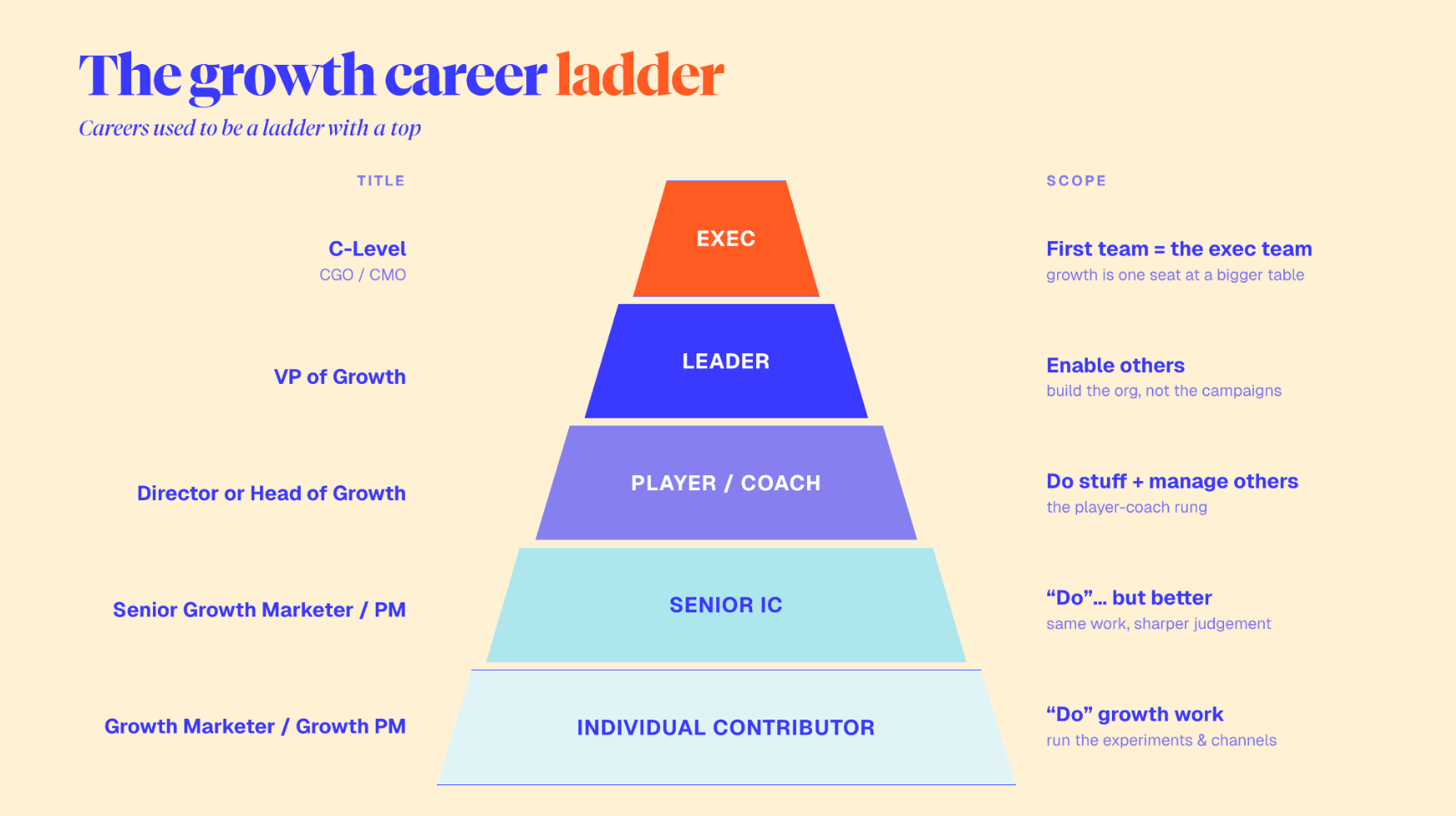
There’s 2 things to note about this ladder.
The first is the connection to management.
As an IC or senior IC, you’re managing yourself. As a director, it’s typically a player-coach role, so you’re still managing yourself plus a handful of direct reports. As a VP, you’re usually managing a larger team. And in the C-suite, you’re typically managing other managers.
The second is the connection to the amount of money you make.
There’s a direct correlation between your title, how many people you’re managing, and your paycheck. Being a people manager was our avenue to more budget, more status, more influence, more impact.
And historically, stepping down from leader to doer wasn’t a good look.
It was something you had to explain in interviews. It looked like you couldn’t hack it. Like you weren’t successful. Like you weren’t ambitious.
The ladder became a loop
It’s important to note the career ladder and the skills required to climb the ladder are separate things.
The skills stayed fairly unchanged. You stack skills to get from IC to senior IC to director to VP to C-suite. There are some new skills with AI (new tooling, tech stack, playbooks), but the shape has been fairly consistent.
The career ladder is where the major changes happened.
In 2026, the titles are still pretty similar, but instead of a ladder that goes straight up, it now looks more like a loop. Same roles available: IC, senior IC, director, VP, C-suite, etc.
And once you make a certain level of seniority, you can choose to go back to being an individual contributor.
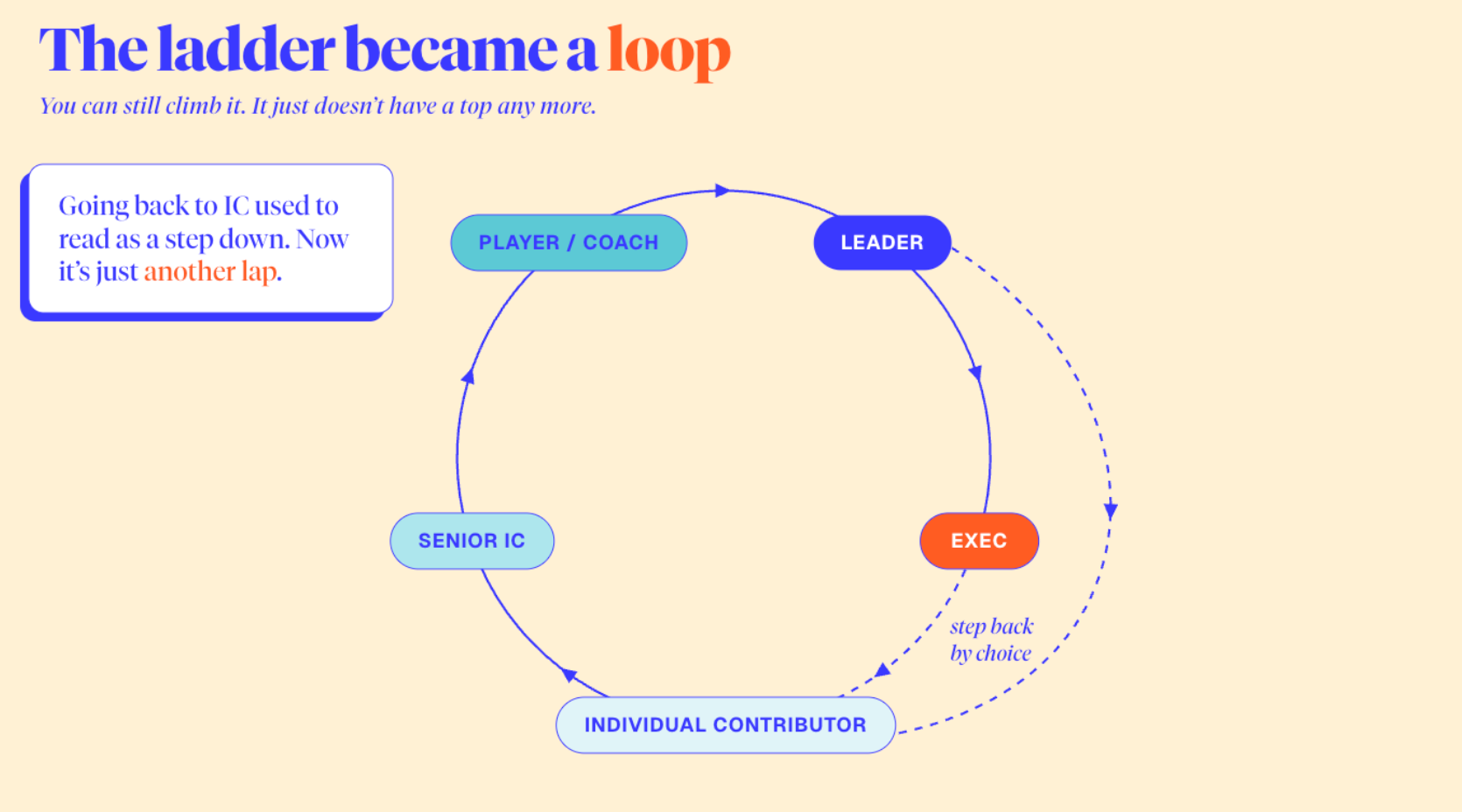
But it’s a different type of individual contributor. Higher-status, higher-paying, higher-influence, and higher-impact.
Making another pass around the loop adds more value.
Because you’ve stacked more skills, which makes you way more valuable as an IC when you come back to that seat. And AI has compounded this and made it even more valuable than I think any of us could have anticipated.
The skills ladder is your ticket to ride this loop.
That distinction really matters, because if you don’t understand it, you might make the wrong decision: either chasing a title change when you should be stacking skills, or turning away an amazing opportunity because it looks like what historically had been a step down or a demotion.
The skills ladder got re-weighted
As a coach who supports directors, vps, and heads of growth - I get asked to review a lot of those JD’s.
And today, they’re way longer. They include way more stuff than they did a few years ago. They’re weirder. Half still kind of reads like the jobs we’ve done historically. The other half reads like it’s been borrowed from an engineering spec.
To oversimplify, most of our skills fit into 1 of 4 buckets:
Tactical skills
Management skills
Soft skills
Personal attributes
Historically, tactical skills carried entry-level value.
Management skills kicked in around the director/ player-coach level. Soft skills got more valuable as you climbed from director to VP into the C-suite. And personal attributes are the things you bring with you that make you uniquely you.
But the weighting on these 4 buckets just got totally redone.
Tactical skills, which used to matter most when you were an IC, are now weighted way heavier. There are new rungs on the skills ladder: AI fluency, prompt engineering, leveraging MCPs, managing agents, shipping your own work into production end-to-end, getting into code. These skills mostly didn’t exist a couple years ago. Now they’re at the top of the JD.
Management skills changed in shape more than weighting. Today’s teams are smaller - and skewing towards more generalist. Some of my Director and VP clients only manage 2-3 in-house generalists + a bench of external specialist contractors/ freelancers. A few of them manage a team of agents instead of people, which didn’t really exist a few years ago either. The core skills are what you’ve known historically: task-relevant maturity, sharing your thinking in a way that enables others, helping them problem-solve. But we’ve added a bunch of new management types.
Soft skills, I believe, are worth more than ever before. Because when 1 person can do 10x the work they ever could, and execute end-to-end the kind of work a team of 3 or 5 used to do, communication, buy-in, and alignment become more important than they ever have.
Personal attributes Adaptability, speed, hustle, grit, curiosity, and the ability to just figure stuff out are some of our most important skills today. Because we’re navigating such crazy change, the folks who charge head-first (vs folks who prefer the “ways we’ve always done it,”) will be the ones leading us into the future
If you’re not sure what to do, here’s my best advice…
Pull a couple job specs from other companies hiring for your exact title. Highlight everything in there that wasn’t in your job spec 3 years ago. That is the set of skills you need to focus on picking up to keep navigating the career loop.
What those skills unlock
One of the VPs I support described the top of the old career ladder like this:
“It was really cool. I’ve achieved this title that I’ve always dreamed about, but the truth is, I wasn’t doing any of the work that I loved so much anymore. I was just in meetings all day, every day.”
Your calendar gets full of other people’s work, other people’s priorities, other people’s problems to solve. And for longer than I’ve been working in and around tech, there was really nothing you could do about that.
Here’s the model that fits better for 2026…
Your career is a loop. There’s no top, there’s no bottom. There are seats around it, and you can move between them in any direction, because every seat you’ve held and every skill you’ve picked up is applicable to the next job.
And you’ve probably seen the market head this direction already.
Elena Verna is a high-profile, high-powered individual contributor at Lovable with executive-level pay. She’s completed the loop, and she’s written about it on her Substack.
Lap 2 feels completely different, because you take everything you learned the first time around with you. You’re an IC that can advocate for budget and resourcing. An IC that’s in the executive rooms, maybe presenting to the board, executing all the things you always wanted to execute but didn’t have the resources (or authority) to do.
Companies used to hire multiple people for this work.
One person to set strategy, direction, and budget, and a separate junior team to execute. Now they’ve got 1 person doing both jobs, and they’re paying that person accordingly.
That’s why your value compounds every lap.
Each trip around the loop adds a job you can do that used to be someone else’s salary. But you can’t skip the first lap. You can’t go from IC to director, jump back to being an IC, and think “well, I’m just gonna double my salary doing this.”
You need to be able to do all of the jobs to have as much influence, impact, and hopefully pay as you want. There’s no shortcutting that process.
The 4 seats on the loop
Your title doesn’t always tell you which seat you’re in.
Two people can have the exact same words in their LinkedIn title and be living in completely different worlds day-to-day.
In my experience, that’s because there are really 4 different jobs to be done.
1. The early-stage builder. This is your IC or senior IC, typically at an early-stage company. Maybe you’re the first growth or marketing hire, likely reporting directly to a CEO or founder. Because it’s early stage, there’s no product-market fit, no playbook, no growth model, no channels you’re already scaling. You’re figuring out all of it: the channels, the data stack, the first version of the ICP, the copy, the initial experiments. The vibes and energy are off the charts in this role because there’s so much freedom and autonomy. The job is basically “figure it out.”
2. The player-coach. Typically a small team, somewhere between 2 and 5. Half your week is doing your own IC work, and the other half is coaching other people on how to ship and execute theirs. In my experience, this is the toughest seat on the loop. You have to manage your time, manage others, do your IC work, drive alignment up the food chain, and learn how to be a manager for the first time. There’s just too much work for one mere mortal.
3. The coach-first strategist. Typically a bigger org, managing a bigger team. Your output becomes your team’s output. The job is about driving strategy, getting buy-in and alignment on it, helping your team prioritize, and giving them air cover so they can get good work done on time. The shipping happens via delegation through other people. And this is the seat where the all-day meetings start.
4. The high-leverage IC. The new one from the top of this piece. No direct reports, a massive surface area, executive-level pay. You ship your own work with AI doing a bunch of the heavy lifting. You delegate to AI, using it like junior employees, and your strategy, decision-making, and judgment are how you figure out what’s worth shipping. This seat is really only available once you’ve made the first loop around. It’s built for people who have already been coaches, leaders, and managers, because a core part of being successful here is your understanding of what good looks like and your ability to push until you get an output that’s high leverage. That’s why the people landing these seats are typically ex-heads of growth or ex-CMOs, and that’s why the pay holds at this level.
Which seat do you actually want?
As a coach, most of the pain I see comes from folks sitting in the wrong seat.
There’s a mismatch between their core passion and skill set and what their actual job is day-to-day. Like an early-stage builder who got promoted, is now leading a big team, and is stuck all day, every day in alignment meetings.
And these roles are so in demand right now that if you don’t define what you wanna do, the market might pick it for you. You might get one of these amazing opportunities that you feel like you have to say yes to.
So here’s a couple questions to ask yourself:
Do you want to manage the work, or do you wanna be implementing and executing it?
Does strategic thinking or more technical execution get you fired up?
When the workday or workweek flies by, how would you describe it?
If you want help figuring out your seat, take my free assessment. It’ll take you a couple minutes.
Somebody in a few years at your company, or your next company, is gonna be the highest-paid marketer on the team with zero direct reports.
It might as well be you.
Want to go deeper on all of this? My friend Daphne Tideman and I are hosting a free live session tomorrow, August 19th: The Rise of the Growth Engineer: The One-Person Growth Team. We’re breaking down her side-by-side head of growth job specs from 2022 vs 2026, plus a bunch of live Q&A based on what you’ve got going on.
I couldn't agree more. But there's a really big BUT...
The loop is completely dependent on organisations having flexible enough career pathing and remuneration policies to enable it. Most organisations don't even bother trying, and many of those that do, don't do it well. I'm not confident that is going to change any time soon.
So, in order to do a career loop, does that mean someone has to leave their organisation?
I don't work with senior leaders often. I work more often with experts and gurus, most of whom are talented IC's or player coaches. Just this week (as of Tuesday), I had one client who has stepped back into an IC role, and another technical guru client, at the age of 58, is considering people management for the very first time.
Ideally, I agree with every word of your article. Someone who spends time leading people and then returns to an expert role doesn't come back as the same expert. They come back better.
They may understand organisational politics differently. They know what it's like to own a budget. They are better able to understand what drives an executive. They've had to make decisions with incomplete information. They've experienced competing priorities rather than simply wondering why the decision-maker won't accept the technically obvious answer.
Those capabilities don't dilute their expertise. They may make that expertise much more impactful. It is something organisations should encourage and nurture. Those that do will become very attractive to the best expert talent.