


Grab my entire 90-day plan. It’s the exact plan I built at Postscript, with a workbook so you can fill stuff in as you read. Download it here.
Or if you prefer, watch the video deep-dive.
If you just wrapped up your first 30 days as head of growth, this is the exact plan I’d follow for your next 30 days.
This is part 2 of my 3-part series on your first 90 days as a head of growth. (If you missed it, part 1 covers your first 30 days.) It’s based on a plan that I made when I joined Postscript, and I’ve revised it based on what I’ve learned after personally coaching 100+ other directors, VPs, and heads of growth since then.
By now, you’re 30 days in.
You spent about a month learning about the business, meeting your cross-functional stakeholders, and figuring out where those biggest growth levers might be hiding. But you’re learning that everyone has a different idea about what growth should be working on.
And if you’re not careful, you’ll spend your second month (and probably every month after that) working on everyone else’s priorities instead of your own.
Step 1: Create your growth strategy and your growth operations manual
You’re a third of the way through your 90-day plan, and that plan is all about ramping up. But by now, you’ve learned a ton of stuff about the business, about the funnel, about the people. Now it’s time to turn your attention to the bigger question.
How are you going to grow this business?
An academic answer, based on content you’ve consumed or talks you’ve listened to or social posts that seemed relevant and interesting, only gets you so far.
You need to know how to grow it at this company, at this stage of growth, in this moment that this company’s navigating. With this team, with these cross-functional stakeholders, with this existing process, and with these resources that you need to figure out how to work with.
These 2 artifacts are how you answer that. And they’re going to help you make the jump from someone who’s right to somebody who’s really effective.
Your growth strategy - what you’re doing, why, and what it looks like when you get there
The first artifact is your growth strategy. At the highest level, it outlines what you’re going to do, why you’re doing that, and what it looks like when you get there.
And having this matters, because without something written down, without an artifact, it’s really hard to prioritize.
You can’t protect your priorities if they only live in your head.
Sometimes I hear from folks who work at super early-stage companies, and they’ll say, “We don’t really need to do this at my company. I work at an early-stage company. Nobody else has like a formal strategy documented. Things are more fluid here.”
I get that. But the truth is, you do need this. And if you’re at an early-stage company, maybe even more so than anybody else.
At other stages, scaleups and enterprise companies ask you for your strategy. But when you’re working at a startup, typically you’re the one presenting it to others.
And the reason this is so important for you is because these are the folks that tend to have a million ideas and changing priorities tossed their way on a weekly, if not daily, basis. This is one of the tools that’s going to help you navigate that challenge.
There are 6 things I’d include in my growth strategy:
Mission and vision. Mission = what you’re focused on and why. Vision = what it looks like if you’re successful. You can describe that for “non-native” speakers, ie folks that don’t work on growth problems every day.
The actual plan. It’s kind of the meat and potatoes of your strategy. I like to use the GST framework for this. Starting at the highest level, what is your goal? That’s the G. The S are the levers or the strategies you’re going to pull to achieve your goal. These might be different areas of the growth model, written quantitatively in terms of outcomes, like “improve activation from X to Y” or “increase acquisition from Y to Z.” And the T are the tactics that ladder up to each one of those strategies or levers, which ladder up to your goal. G, S, T - 3 layers of the cake.
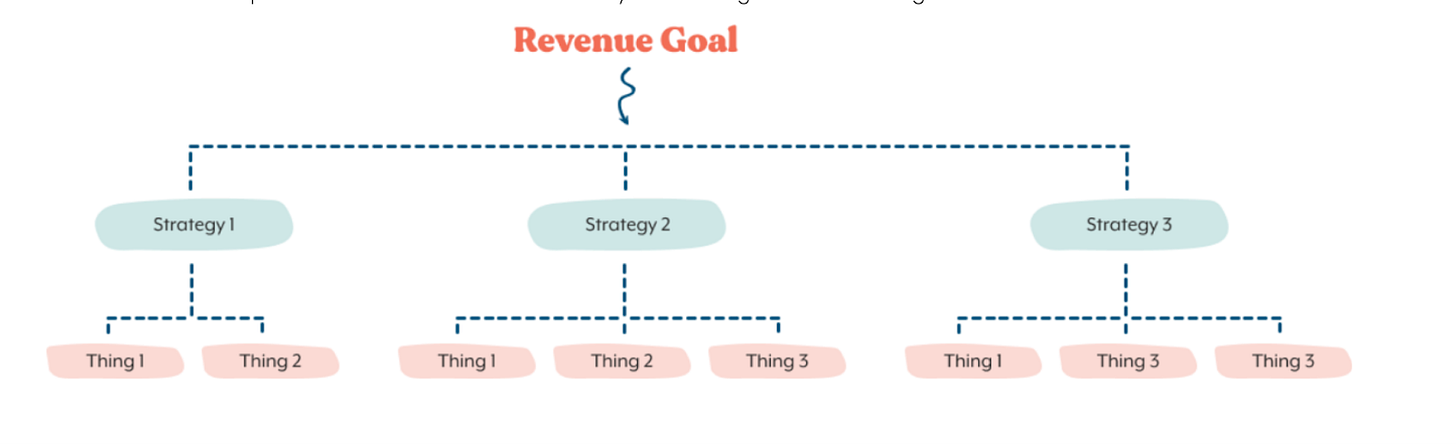
How you’re going to measure success. These are going to be your OKRs.
A visual roadmap. It shows what you’re going to sequence first and what you’re going to do later, ideally with a mix of quick wins and some bigger, longer-term bets mixed in there as well.
The resources you’re going to need to be successful. These could be people, tools, or budget. You know you’re going to need some help executing on your roadmap in service of your goals.
The threats. You want to outline the risks or the roadblocks that might derail the plan, so they don’t catch anyone (especially you) off guard down the road.
I like to write all this stuff in plain English. No acronyms or jargon, because most of the people consuming this information don’t live and breathe the growth world every day like we do.
Your growth operations manual - how growth gets the work done
The strategy outlines what you’re working on and why. The operations manual outlines how you’re going to go about the work. IE, how you collaborate with other teams, how you track your process, how you run experiments, how you approach important decisions, all that kind of stuff.
And this is incredibly important, because working in growth is fundamentally different from traditional marketing, product, or data teams.
The lines of ownership are different. The way we approach our work is different. The testing, the experimentation, the iteration. Most teams don’t approach solving problems that way.
So if you don’t spell this out proactively, other teams won’t know what to expect from you, and you’re probably going to bump into a bunch of cultural roadblocks down the road.
For a new head of growth, I’d start with 6 sections in your growth operations manual.
What your team looks like. Ie, the org chart. I like to create 2 of these. One outlining what the team looks like today. The other is what the org chart looks like if you fast forward 1-2 years down the road, so everybody knows what to expect.
A KPI scorecard. Both a list of metrics you’re going to be tracking in service of your goals, and who owns each one of those metrics.
Your operating principles. Sometimes I use the word values synonymously here. Basically, how you want your team to make decisions when you’re not in the room. Some examples that have been in my operations manual in the past: being focused on learning and enabling other areas of the org, putting users’ opinions in front of our own opinions, and having a bias toward simple solutions that scale, etc. This can help you create cultural change based on where your company’s baseline is today, so tweak those accordingly.
Your cross-functional rules of engagement. I mentioned that working on a growth team is fundamentally different from other teams: different in approach, and way more cross-functional. That’s a pro and a con, because if you don’t define how to work with other teams, you might end up bumping heads for way too long and not being as productive as you could be.
One of the tools I find really helpful here is a RACI matrix, which is a cross-functional project management framework. R is who’s responsible, A is who’s accountable, C is who’s consulted, and I is who’s informed.
I like to outline both the KPIs and the surface area, then make sure it’s crystal clear by filling out each RACI letter for each one.
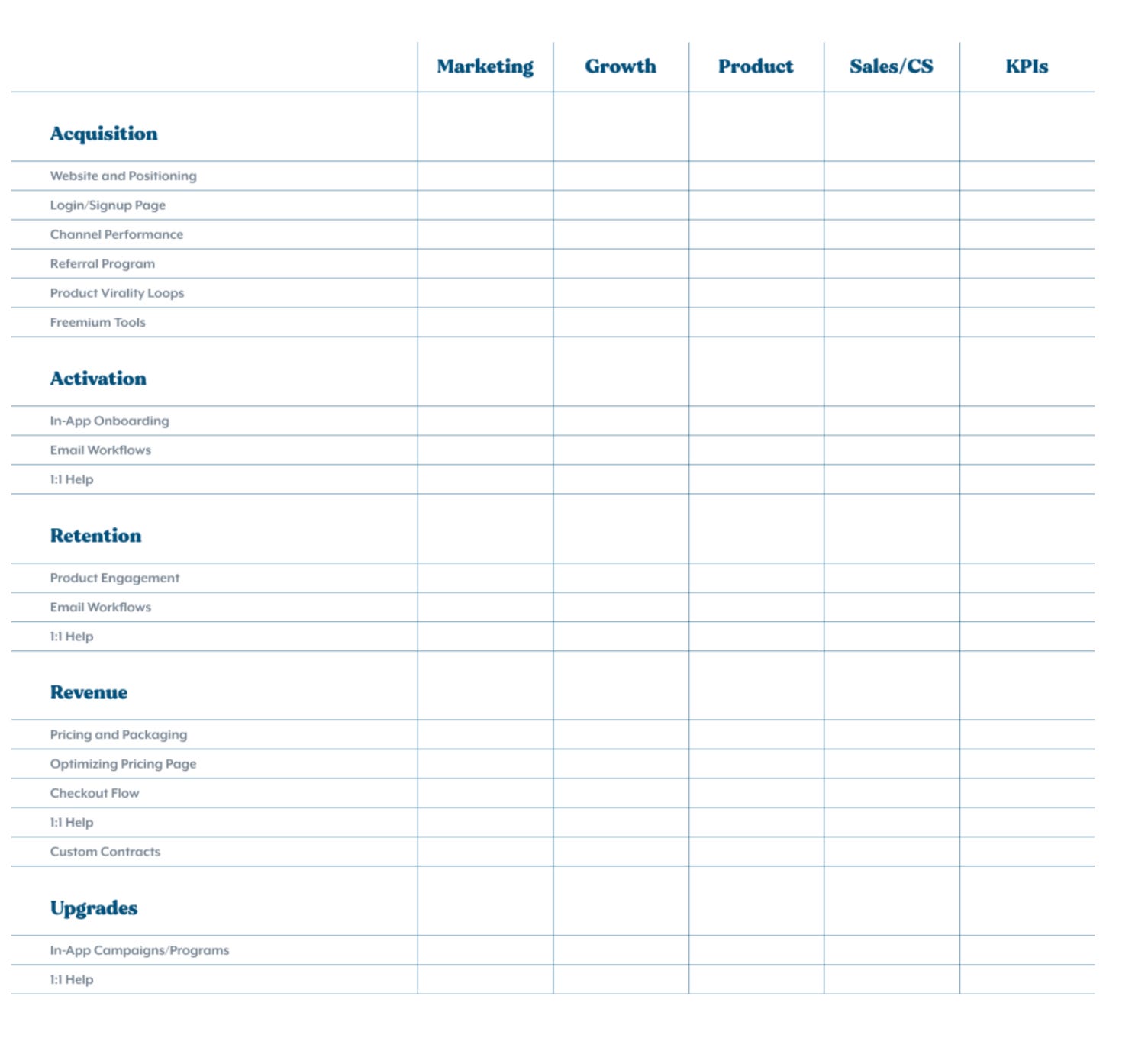
For example, you might be ultimately accountable and responsible for your activation rate. But onboarding emails might be owned by a lifecycle marketer.
And on the flip side, for your pricing and packaging page, your designer might be heavily consulted in that work, but there are going to be a bunch of other teams that need to be informed as you make changes.
Defining this stuff up front allows you to go faster later. That’s why it’s in your operations manual.
Your meeting structure. Typically, growth has a few different types of meetings. You’ll have planning meetings, learning meetings, and alignment meetings.
Your important SOPs (standard operating processes). The big one in growth is defining specifically how you brainstorm, how you prioritize, and how you run experiments. If you define that stuff up front, and you have documents and templates that help you do it, everybody knows what to expect from you. And anybody new who joins your team knows exactly how to plug into your operating processes and your systems.
Ideally, these 2 documents link to each other.
You’re going to keep updating them as you learn. This is your second month as head of growth, so you’re just drafting your first version of these. (I also have a whole video breaking down each one at length, if you want a deep dive into the 2 most important artifacts for a growth leader.)
Share both drafts before they’re polished
Once you’re done drafting these documents, you want to share them. A huge part of your success or your failure is your ability to manage up, and these 2 artifacts help.
Start with your manager. Walk them through your drafts and ask them a couple of questions:
Based on what I’ve got here, how might you change the way that I’ve prioritized and thought about these challenges, especially with our strategy?
If we could fast forward into the future and I was not successful for some reason, what would be the most likely reason or reasons why?
Based on the feedback and the answers you get, you might want to make some changes.
Once you’ve shared them with your manager, share them with the peers you met during your first 30 days. A lot of them gave you amazing ideas on how to grow the business, and this is a nice chance to show them that you listened.
Sharing this stuff early, while it’s still in draft, allows you to get more input while there’s still time to act on the feedback. And if you’re headed in the wrong direction, you’ve got plenty of time to redirect your energy and your approach.
The trap here is trying to make these 2 artifacts perfect before you share them with other folks.
And I get where this comes from. Especially when you’re hired to be the expert. You’re the head of growth. You’re the head of the capability. You want to show people what an expert you are by thinking through all the nuances and then presenting it as a finished body of work.
But I’ve worked with so many people who have made this unfortunate mistake.
If you wait until they’re polished, you lose the most valuable part, which is getting input early enough to change course.
So if you haven’t done this already, prioritize those 2 artifacts. Start with the strategy. Put together everything you learned in your first month (your growth model, your customer research, all those ideas that you had as you got to know folks) and fill in those 6 sections. Then do the same thing with your operations manual.
Once your stakeholders have had a chance to review all this stuff, and you’re aligned on what you’re focused on, why, and how you’re going to approach the work, the next question is, “what resources do we need to pull it all off?”
Step 2: Line up the people, tools, and budget before you need them
After the first step, you know what to focus on, and you’ve got confidence it lines up with what the company had in mind for you, your role, and your success.
Now you need to figure out what it’s going to take to actually execute on this.
The earlier you have clarity about what resources are available, the better. Approvals take time. Budget requests take time to review. Design and engineering usually take a little bit of time to get things into their scope and their roadmap, and that stuff tends to happen weeks and weeks in advance.
So you want to get to this early.
The 4 resources I’d look at
1. Cross-functional help. In growth, that’s typically going to be design and engineering.
With all the AI tools available today, your growth team needs less design and engineering help than it ever has historically.
But you still need help deploying things to production, making backend changes, and taking any of the big swings you’ll want to make.
You can certainly ship some small stuff on your own. Like UX changes, copy, design tweaks, and front-end stuff. But if you’re taking big swings (which hopefully you and your team will be doing sooner rather than later), you’re going to need help from those teams.
Which means either you need resources solely dedicated to supporting your growth efforts, where you get to own their roadmap and their prioritization.
Or you need dedicated access to other teams’ resources and their roadmaps, which means getting your ideas on their radar, on their backlog, and on their roadmap early.
This is where everything you learned in your first month about how the company gets its work done today is going to pay off. Get your asks into their sprint planning, and slide them seamlessly into the way they already work.
2. Tooling and tech stack. Reporting, A/B testing, user testing, whatever else your growth programs need. Take a peek at what already exists in the stack before you ask for anything new. But your growth model probably showed you where some of the gaps are already.
3. Budget. It’s going to help you execute on or acquire any of the things I already talked about. That might mean contractors, freelancers, additional hires, maybe an agency, and these days probably some agents as well.
4. Customer insights. If you don’t already have a crystal clear picture of the problems and opportunities, this is the time to get some more research going. That could be user testing, research or survey tools, or even some deep research on your back-end customer data.
Tie every resource ask back to your plan
The trap here is asking for resources without tying them back to your plan. And unfortunately, I see this way too often in my coaching practice.
Folks will walk into a resource conversation and they’ll say, “Hey, we really need this A/B testing tool. We need a designer. I need a marketing ops person. I have all these things that I need to do things the right way.”
That might be technically correct. But it’s a really tough way to get a yes when you’re asking for more.
Instead, walk in and say:
“Hey, here’s my goal. Here’s the plan I’ve got to achieve my goal. Here are the milestones I’m going to be looking at along the way. And here are the resources it’s going to require to execute on this plan and achieve my goal.”
It’s going to be way easier to get a yes.
Once you’ve got your strategy, you’ve outlined how you’re going to approach the work, and you’ve acquired your resources, it’s time to start shipping.
Step 3: Start shipping, and protect your roadmap while you do it
It’s going to take a few months before you get into a good rhythm at a new company. Expect it to feel a little clunky at first. That’s totally normal.
And this is usually when all those ideas really start rolling in. Working in growth, people are going to send you a ton of ideas every day, every week.
Some of them are going to be good ideas. Some are going to be great ideas. And a whole bunch of them are going to be cool ideas that are probably distractions.
If you’re a people pleaser like me and you say yes to everything because it feels good, you’re going to end up spread too thin. And the roadmap you just shared with everybody (the one you just got everybody aligned on) is never going to get done.
Give every idea a home in your backlog
You do need a system so that everybody sharing ideas with you can feel heard. That’s an important part of being a leader.
Which means you need a place to address and store all of these ideas, even the ones you’re going to say “not right now” to.
So start a backlog. A running list of all the non-essential projects people send your way. Every idea gets cataloged and written down, so nothing gets lost. Then re-evaluate that backlog every couple of months.
When those requests start coming in (sales asks you for something, marketing suggests something different, the product team has another idea), you can point at your strategy and say:
“Look, this is our growth strategy. This outlines what we’re focused on and why. I personally love this idea. I’m going to add it to our backlog, and I’ll follow up in a few weeks when we re-evaluate whether we add it to our next sprint cycle or not.”
That’s a great way to balance staying focused on what you need to achieve your growth goals, while also making sure nothing gets lost and everybody feels heard along the way.
Saying yes to everything and saying no to everything both cost you
There are 2 traps here. I already talked about one - saying yes to everything and giving away your roadmap, which would be a waste.
The other trap is saying no to everything without explaining why.
Amazing, smart, talented folks are going to share their best ideas with you. Then those ideas go into a black box. You never follow up, they never get executed, and those people are stuck wondering why they even bothered to share the idea in the first place. You lose a lot of the goodwill you were able to build in your first month.
The backlog is your tool here. It lets you say, “Hey, I’m not doing this right now.”
The plan I’d follow in month 2
That’s the plan I’d follow in your second month as head of growth:
Create your growth strategy and your growth operations manual.
Share them for input, ideally while they’re still drafts, before they’re finished.
Prep your operating system.
Start shipping while you protect your roadmap with that backlog.
Again, the full plan is in the free workbook. Grab the full 90-day plan here.
This is part 2 of 3. If you missed it, part 1 covers your first 30 days. Next up, I’m covering days 60 through 90. Subscribe so you don’t miss it.
Want some help? If you’re in your first few months as a head of growth and you want some help hitting your growth goals, running your growth team, or accelerating your career as a leader of a growth team, those are some of the things I can help with as a coach. Set up a consult and see if we jive.