


Grab the guide I give every growth lead. It includes the exercises from this post. Download it here.
Or if you prefer, watch the video deep-dive.
Below, I’m going to break down the main differences in ownership and accountability between the head of growth role and the head of marketing role.
Right now, I’m helping a VP of growth work through this exact situation.
His company just brought in a head of marketing. But up until very recently, he had been leading both the marketing and the growth orgs. So now we have 2 leaders in place who need to detangle who owns what, and quickly.
If you’re in that situation, or you’re about to accept a new role and you’re not sure exactly how you’re going to draw lines between the teams, this is going to be a big help.
For context, I’ve been a head of growth twice. I’ve led multiple marketing teams, and I’ve coached 100+ other heads of growth and heads of marketing over the past 5 years.
I’m intimately familiar with how these 2 roles overlap and intersect. By the end of this post, you will be, too.
Step 1: Define what success looks like for each team
Let’s start with what success looks like for each one of these capabilities. Because if we’re not on the same page about what good looks like for our role and for our team, we’re going to run into all kinds of challenges down the road.
If everybody has a different definition of success, it makes it nearly impossible to figure out how to prioritize, what to do, and what you should not be doing. And we’re going to end up bumping into all these other teams down the road.
Most leaders who struggle in a new role skipped this conversation
This is the number 1 challenge I typically see when someone hires me as their coach. They’re a few months into a new role and it’s not going as well as they were hoping, for whatever reason.
Almost always, it’s because they haven’t taken the time to slow down and define exactly what good looks like for their role, and then have a specific conversation with their core stakeholders (their executives or their cross-functional peers) to detangle and align from the get-go.
I learned this because I lived it at Postscript.
I was initially hired to be the head of growth. But as a company we didn’t have a head of marketing yet.
So I got to help build out the first version of that function as well. Then about a year in, we hired a CMO, and I got to rotate back into my zone of genius, which is really on the growth side.
When the CMO first started, we needed to sit down and get on the same page about what outcomes each of us were excited to drive. That helped us detangle who owns what with a lot of the work, which is what we’re going to get into in a second.
Growth owns self-service revenue and number of customers
I want to share how I actually think about success for the 2 capabilities, in terms of outcomes.
I think about growth as being e-commerce for software teams.
Especially if you work in a product-led environment, growth is going to own the self-service side of the business.
So in terms of outcomes, growth is typically going to be accountable for self-service revenue and number of customers. Those are the 2 outcomes that most of your growth work is going to ladder up to.
In terms of the actual strategy, growth will usually be focused on the input metrics:
Acquiring new users
Onboarding and activating
Conversion from free to paid
Upgrading users between plans
Retention and churn prevention
Marketing owns pipeline and sales-assisted revenue
Most product-led growth organizations still have a sales team.
So typically marketing is going to be accountable for driving pipeline and sales-assisted revenue. Those are 2 of the outcomes.
To get to those outcomes, marketing is going to be focused on the inputs, which are typically:
Growing awareness of your product in the category
Building an audience through social media, content, and email
Converting that audience into traffic on your website
Driving leads from that traffic that convert into qualified leads
Supporting sales to convert those leads into customers
All the inputs to drive the outcome of more pipeline and sales-assisted revenue.
Map your growth model to see where the lines fall
If you’re not sure how to detangle this from an outcomes perspective, I find it really helpful to create a diagram of the growth model. Essentially, a map of how a user flows from never having heard of your organization to eventually becoming a paying customer.
I like to do this visually.
You can use a tool like Miro, or a whiteboard if you’re in person, however you prefer. Diagram out the different flows and paths a user could go through, and then think through the KPIs and the outcomes for each one of those paths.
When you do this, it helps you figure out what success looks like for each one of the capabilities and define some of the KPIs that are going to be owned by one group versus another group.
It gives a ton of clarity, but it will raise new questions about who owns what.
Step 2: Run a RACI on both the KPIs and the surface area
We just talked outcomes. Surface area and execution are incredibly important too, because there are some KPIs where multiple surface areas owned by different teams get touched. I lived this at both Postscript and Wistia.
Growth can own an email outcome even when marketing owns email
Email nurturing is a great example. Email nurturing would typically be owned by a marketing team.
We talked about marketing owning the outcome of building the audience that eventually converts into pipeline. Nurturing your email list so it continues to grow over time and eventually turns into that pipeline is a core responsibility for the marketing org.
That said, there are times when we might want to use email nurturing to assist with growth goals. Examples of that would be:
New user onboarding and activation work
Getting self-serve customers to upgrade from the pro to the premium plan
Trying to save a user who is at risk of churning
For those types of campaigns, we might want to collaborate with the marketing team, but the growth team is probably going to be the one accountable for the outcome of that work.
That’s a great example of an area where ownership, accountability, and surface area start to get a little bit fuzzy.
In-product messaging gets fuzzy the same way
Another great example is in-product communication. Let’s say you’re a SaaS business. Many of them have communication inside the app (popups, banners, things like that) at different points in the lifecycle.
Sometimes the marketing team might want to announce new features. At other times, the growth team might want to use that communication channel for some of its outcomes, like retention work and upgrades.
Again, marketing can be a collaborator on those KPIs, but it probably wouldn’t make sense to have the marketing team accountable for the results.
And there are a bunch of examples like this.
List every surface area in your growth model, then RACI each one twice
What I like to do here is list out both the core surface area related to our growth model, and all the potential teams that might be collaborating on those surface areas. For each line item, I like to talk my way (or think my way) through a RACI matrix.
If you’ve seen any of my other content, you’ve probably heard me reference this in the past.
It’s a great cross-functional project management tool that creates a ton of clarity around ownership and accountability, and it probably makes sense for you to do one here.
What’s really important is that for every line item related to your growth model, you do a RACI for both the KPIs (the outcomes) and the surface area (who owns what when it comes to the individual channels and execution).
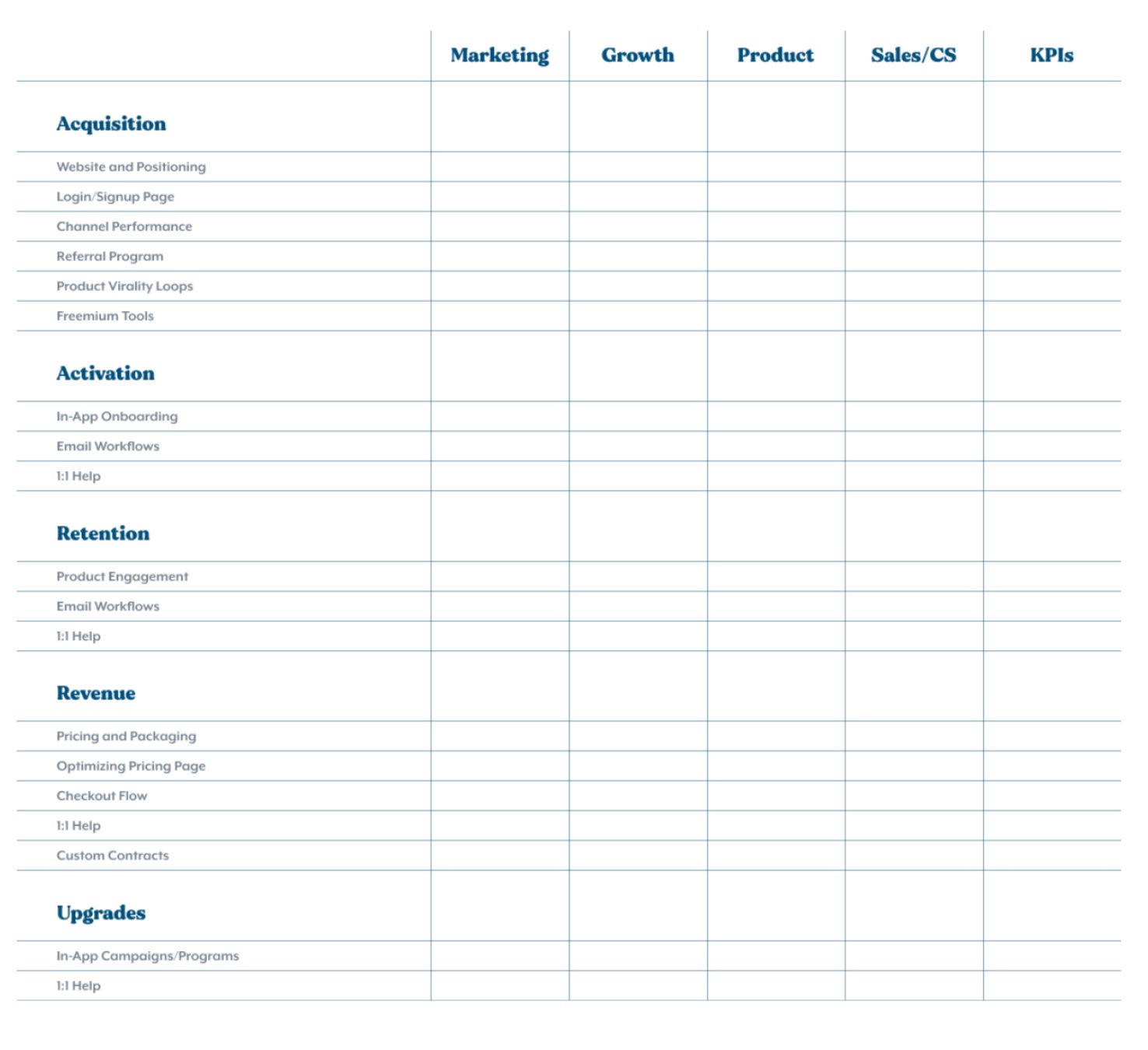
You might find that in many cases growth owns the outcome or the KPI, but the surface area might not necessarily report up to the growth organization. That helps you identify collaborators. People who needs to be consulted in the process, and we need to make sure we pull them in when we take on and scope that type of work.
Build it with your peers and revisit it every 6 months
If you haven’t done this, take a few minutes and list out who’s going to be responsible, accountable, consulted, and informed when it comes to the core surface area as well as the KPIs related to your growth model.
Ideally, you want to do this collaboratively with your cross-functional peers, so it’s not done in a silo. And you might want to revisit it every 6 months if your company’s going through a high-growth period, because the details of the growth model and your resources internally are probably both going to change.
Step 3: Agree on how you’ll work together before you get deep into execution
Defining who owns what gives us a ton of clarity. That’s helpful. We still need to define how we’re going to collaborate with our counterparts.
This is hard when it comes to both growth and marketing work, because a lot of that work is going to end up overlapping or bumping into other teams.
If we haven’t defined what great collaboration looks like in practice, it would be easy for us to end up bumping heads with those other teams, even with the best of intentions.
Some tension between growth and marketing is healthy
And there are different types of tension.
Sometimes that tension can be unhealthy - teams are frustrated with each other, they’re bumping heads, they’re fighting. That leads to less productivity.
And sometimes that tension can be healthy - with growth and marketing each owning a different part of the go-to-market and revenue model. We just might need to figure out how to grow the total amount of revenue without stealing or cannibalizing from the other side.
Walk the growth model together and agree on the handoffs
Once we have clarity about what our growth model looks like and who is going to own what across the different outcomes and the surface area, we want to take a few steps:
Diagram out that entire growth model, if we haven’t already.
Walk through that entire experience together, soup to nuts.
Agree on the handoff areas. Where does marketing’s work end? Where does growth’s work begin? Where are the lines between commercialization on the self-service side and commercialization on the sales-led side?
Agree on how we’re going to work together: the rules of engagement based on the surface area we share, and how we’re going to collaborate.
Pick a regular time to review both the rules of engagement and the KPIs together.
This is exactly what I did with that VP of growth I mentioned at the start.
Name your different working styles before they show up as friction
The other thing worth talking about up front is how each team operates, how they get the work done.
Marketing tends to ship work based on brand and taste. They want everything to feel cohesive. Growth is a little bit more iterative. There’s more testing, more segmentation, more question asking.
Both are useful. But if you don’t define the different working styles and operating systems early, it might show up (or be viewed) as friction later, especially on shared surface areas like the website or in-product messaging.
So if you haven’t done it already, sit down with your counterpart, bring out your growth model, talk through the RACI matrix, work through all that stuff together, and then agree on the handoffs before you get too far into execution.
How I’d split ownership with a new head of marketing
That’s how to think about the differences between the head of growth role and the head of marketing role:
Get clear about what success looks like for each one.
Figure out who owns what, for both the KPIs and the surface area.
Agree on how you’re going to work together with your counterpart.
If you’d like that RACI matrix, or other content to help you lead your growth team, it’s all in the free guide I give to every head of growth I work with. Grab the head of growth guide here.
Want some help? I work with directors, VPs, and heads of growth on the 3 most important parts of the job: figuring out their growth strategy, running their growth team, and leveling up their skill set along the way. If you’re interested, check out my coaching page and reach out if it seems like we’re a match.