


I’ve coached over 90 growth leaders over the past 4 years.
Mostly Directors, VPs, and Heads of - but occasionally a really ambitious senior IC too.
And I’ve noticed something that still surprises me: many really talented people get stuck at the Director level, because they focus on the wrong things.
So today, I’m sharing the exact framework I use to help leaders break through.
It’s called the Influence & Impact Map. I used it myself when I went from running marketing campaigns to leading cross-functional growth teams at two fast-growing companies. And I’ve used it with Directors, VPs, and department heads to help them move up.
We’ll cover where you might be stuck in your career, what the path ahead looks like, and the specific steps you need to take to get there.
Here’s how it works.
The Career Journey
Growing a career isn’t a straight climb.
The skills that get you from individual contributor to senior IC won’t be the ones that get you to manager or director. At each stage, your role changes. What “good” looks like changes. The way you need to share your work with others changes completely.
The journey loosely looks like this:
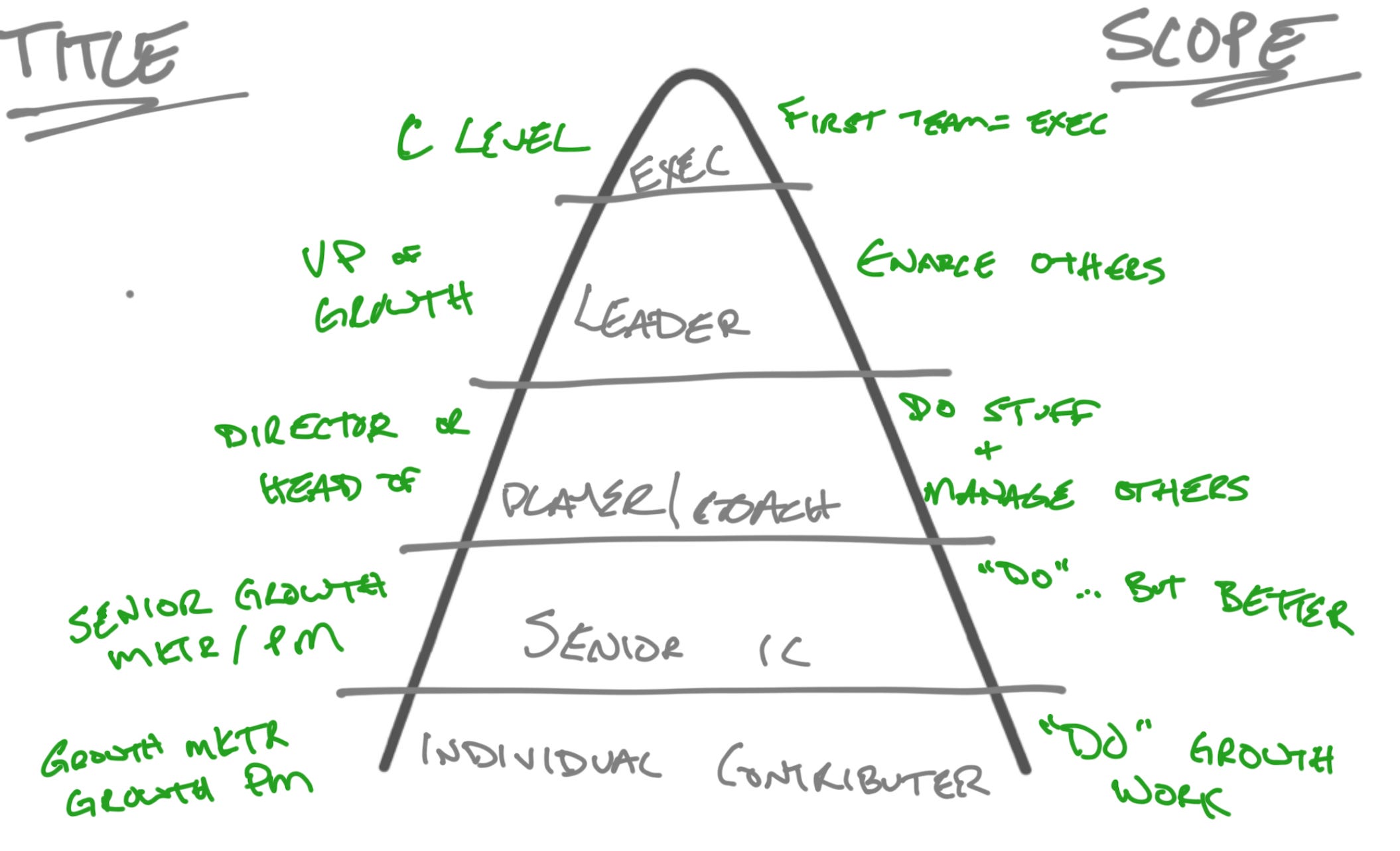
Team Member → You’re doing the work. Learning fast. Everything is new, exciting, overwhelming.
Senior Team Member → You’re still doing the work, but better. With more ownership and freedom to make decisions.
Player-Coach (Director at mid-size companies or department head at smaller companies) → You have your own work AND you’re managing others. You’re finally getting invited into the important rooms where big decisions are made. You have more responsibility, more influence internally.
This is one of the hardest stages. You’re overworked, under-resourced, and everything breaks because IC tactics don’t scale to teams. This is where burnout happens.
Leader → You’re setting direction and helping others be successful. The work happens through your team, not by you.
Executive → You move beyond your specific functional lane. The executive team becomes your main team. Less than 1% of workers make it here, but it’s the top of the mountain many people are aiming for.
Where People Get Stuck
Most people can make it to the player-coach level just from working hard.
From being passionate about what they’re doing and staying on top of the latest tactics and strategies. But it’s at this level that you need to change your relationship between time and effort.
To be successful at the next leadership level, it’s not about working longer or harder and being the best “doer” on your team.
It’s about finding amazing people and setting up the right systems for others to do the work. Otherwise, your career will stop here.
Regardless of your level today, the most common mistake I see is being focused on the wrong stuff for your stage.
Directors still acting like the expert on their team who does all the work. Or junior team members copying the strategic work from senior leaders at larger companies (which is also the wrong move because you’re missing all the contextual pattern matching).
You need the right playbook for the moment you’re in.
The Influence & Impact Framework
Let me walk you through the framework I use to help leaders dramatically increase their influence and impact.
(If you’re just looking for quick wins or a shortcut or a hack, this probably isn’t for you.)
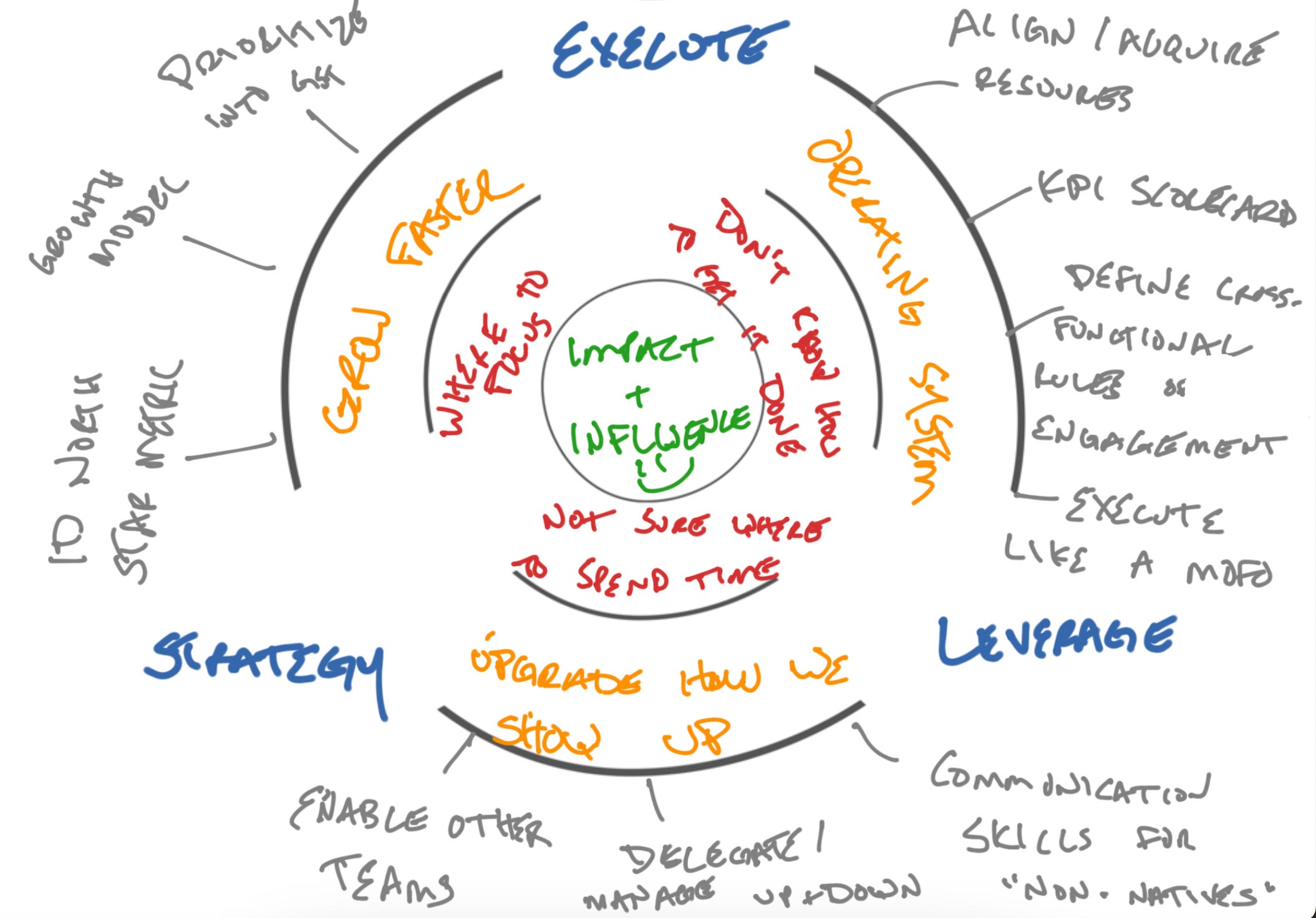
Here’s why you need both impact and influence…
For a long time, the growth community was obsessed with winning. With figuring out how to grow faster, learning all the latest loops and playbooks, being the most data-driven, the most technical, the most obsessed.
But I’ve talked with a lot of folks who knew exactly how to win and still struggled to be effective, because they didn’t have influence.
They’d get stuck trying to explain their ideas to executives. They wouldn’t be able to get resources to execute their plan. Or they’d get the resources but wouldn’t know how to delegate or present their work outcomes to senior leaders.
Being right isn’t enough. Being effective isn’t enough.
You need both impact AND influence. That’s what actually moves your career forward. And when you have both, your career doesn’t just advance. It gets better. Your stakes might get higher, but you feel more focused. You’re working fewer hours. Your stress levels are hopefully going down, not ramping up.
Regardless of your current title, level, or specific ownership area - the goal is the same. Move up the ladder and increase your influence and impact.
The Three Requirements
To get there, three things must be true.
We have to focus on the right stuff to grow the business.
We need to execute really well on what we’re focused on.
We need to gain leverage (which looks different based on how senior you are). So that as we’re doing more stuff and becoming more senior, we’re able to level up and life gets better.
On the focus side, our job is to grow faster. On the execution side, we’re setting up an effective operating system (whether for ourselves or our teams). And to make sure we don’t get stuck at this level, we’re upgrading how we show up, make decisions, and communicate to others.
When we’re growing faster, executing really well, and showing up with more intention, work slows down again and becomes fun.
The Practical Menu (Self-Check)
This isn’t an instruction book. It’s a menu to pick and choose from based on where you’re at today.
For each item below, self-assess: Green (solid), Yellow (could improve), Red (big opportunity).
Part 1: Focus (The Goal: Grow Faster)
Find Your Main Goal
This is the single most important thing for success. Get clarity on what really matters for your role.
If you’re a marketer, that might be bringing in new users. If you’re a product manager, that might be keeping users active. If you’re a leader, that might be getting people to convert from free users to paying customers. If you’re an executive, that could be the overall revenue growth rate.
Question: If we zoomed all the way out and fast-forwarded one year into the future and you got a massive raise and promotion, what’s the main number/outcome you were able to improve?
Self-assess yourself (green, yellow, or red) based on your ability to clearly answer that.
Map Out How the Business Works
Create a visual map of all the things (steps customers take or important customer groups) that impact your main goal. Then create a spreadsheet version so you can compare your actual numbers to what they should be and figure out where you can make the biggest difference. Basically, which areas are doing well or poorly.
Figure Out What to Work On
You need to figure out how to organize all the crazy ideas swirling around your head about ways you could improve your main goal into a clear plan. I like to use a template to rank your ideas and another to organize and explain your strategy to other people who need to understand your plan.
Part 2: Execution (The Goal: Set Up a System)
Get the Right Resources
If you’re a team member, this might be tools, data, or technology. If you’re at the player-coach or leadership level, this might look like budget, hiring, and team structure.
Build the Right Dashboard(s)
You know that main goal that everything connects to, but that’s an outcome. You need insight into the right inputs and early signs to prove your work is valuable and fix things before you get too far along.
Set Rules of Engagement with Other Teams
To be successful, we need to work well with other teams. Specifically with marketing, product, and sales (if that applies) so that we’re not stepping on each other’s toes and we’re able to move quickly.
Execute Like the Top 1%
For many of us, this will include designing and documenting tests. If you’re a marketer, this might include building landing pages. If you’re a product manager, this might be designing onboarding flows. But this is the actual “doing” part of the job. Whether you’re doing it yourself or through a team.
We need to know what “good” looks like and hold ourselves or our team to that standard.
Self-assess yourself here. And as you do, I think this is where many of the folks I coach think the core part of their job is. But in reality, this is just one piece of the overall puzzle.
If you’re able to do those things (get the right resources, put together the right dashboards, set rules with other teams, and execute really well), and maybe document all that and turn it into a manual, you should be executing at a very high level.
But it’s not enough to know what to do and get it done.
That gives us impact for sure. We can become a great team member and player-coach by getting really good at these skills. But if we want influence, we’re going to need more. We need to get leverage in other ways.
Part 3: Leverage (The Goal: Gain More Influence)
Many smart, talented people just aren’t sure how to gain more leverage. It tends to be something we’re not taught. Or at least, it’s hard to learn in school. It usually happens in painful moments.
If we want to gain more leverage, there are a few options.
Enable Other Teams
A strong growth leader should be a chief learning and sharing officer. In practice, this looks like:
Learning a lot of stuff (which if you’re doing the rest of the things here, you should be).
Sharing what you learn in ways that help other teams.
A leader must be sharing on a consistent basis. That visibility (and repetition) is an important influence tool.
The way we share also matters. I’m sure you can picture times you’ve seen folks sharing updates that look like they’re just trying to get attention, versus others who do an excellent job sharing decisions and lessons (not updates).
Delegate and Manage Others
This is your ability to get great work done by managing people instead of managing the tasks yourself. It also includes your ability to run meetings, help people learn and work together, and improve how things work.
Becoming a great manager doesn’t happen by accident.
It’s a skill you need to learn, practice, have strategies for, and get repetitions on.
Communicate to “Non-Natives”
The ability to translate your ideas and work for people who aren’t experts in your capability is super important. Once you get to the Director level and above, your main team becomes the other leaders. So you’ll spend less time talking about your work to other people like you and more time translating it into business results everyone can understand.
That’s hard and different. Even the idea of a summary memo for executives was new to me.
What To Do With Your Assessment
Look at your reds and yellows. Pick the THREE that would move the needle most.
Not sure which three? Here’s a cheat sheet:
If you’re an IC or Senior IC → Focus on Part 1 (Focus) first
If you’re a Director/Player-Coach → Focus on Part 3 (Leverage) first
If you’re stuck getting promoted and not sure why → Pick one from each section
Now you’ve got your roadmap.
Start Here Tomorrow
Pick one thing from your reds:
If you picked a “Focus” item: Block 2 hours this week to map your growth model on paper. Just boxes and arrows showing what impacts what.
If you picked an “Execution” item: Schedule 30 minutes with one other team lead to define where your work overlaps - and who should be involved when that overlap happens. Write it down.
If you picked a “Leverage” item: Send one update this week to someone outside your immediate team. Share a decision you made and why.
Don’t try to fix everything. Fix one thing.
Where You Are Right Now
You’ve now got a map of what it takes to level up.
If you’re serious about making that jump to the next level, you’ve got the roadmap. Behind each one of those reds and yellows are specific tools, playbooks, and systems you can start using tomorrow.
Some people prefer to figure this out on their own. Others get there faster with someone who’s been through it, can spot the blind spots, and knows which moves actually matter at each level. Someone to pressure-test your ideas, give you honest feedback, and help you avoid the time-wasting detours.
If having that kind of support sounds helpful, head to my coaching page.
We can jump on a call and figure out if working together makes sense. Or DM me “COACHING” on LinkedIn and I’ll send the link.
And if you’d rather run with this on your own, that’s great too. I hope this framework gives you what you need.
…
(originally published on delivering value)