A quick note before we get into it:
A lot of what makes someone strong in a senior growth interview is the same thing that makes them effective in the seat: getting your ideas adopted by execs.
If “that’s a good idea, but...” is the most common feedback you’re getting, I’m running a free 45-minute workshop on Thursday, June 4. Right Ideas, No Buy-In: A Growth Leader’s Guide to Managing Your Execs.
A client of mine had been in four final rounds for Director of Growth roles.
But she hadn’t received any offers.
She’s a badass marketer with a track record of being an A player. Strong on paper. Very impressive in the room. And by the time she shared what was going on with me, understandably frustrated.
She’s an expert in growth systems, process, and playbooks. So I figured she blew the interviewers away in the early rounds when they were evaluating growth acumen.
But I suspected they were looking for something she wasn’t showing them in the final round.
I told her on a call: “Director of Growth is a player-coach role. I bet you’re acing the player part of every interview. I wonder if you’re highlighting your coach skills enough.”
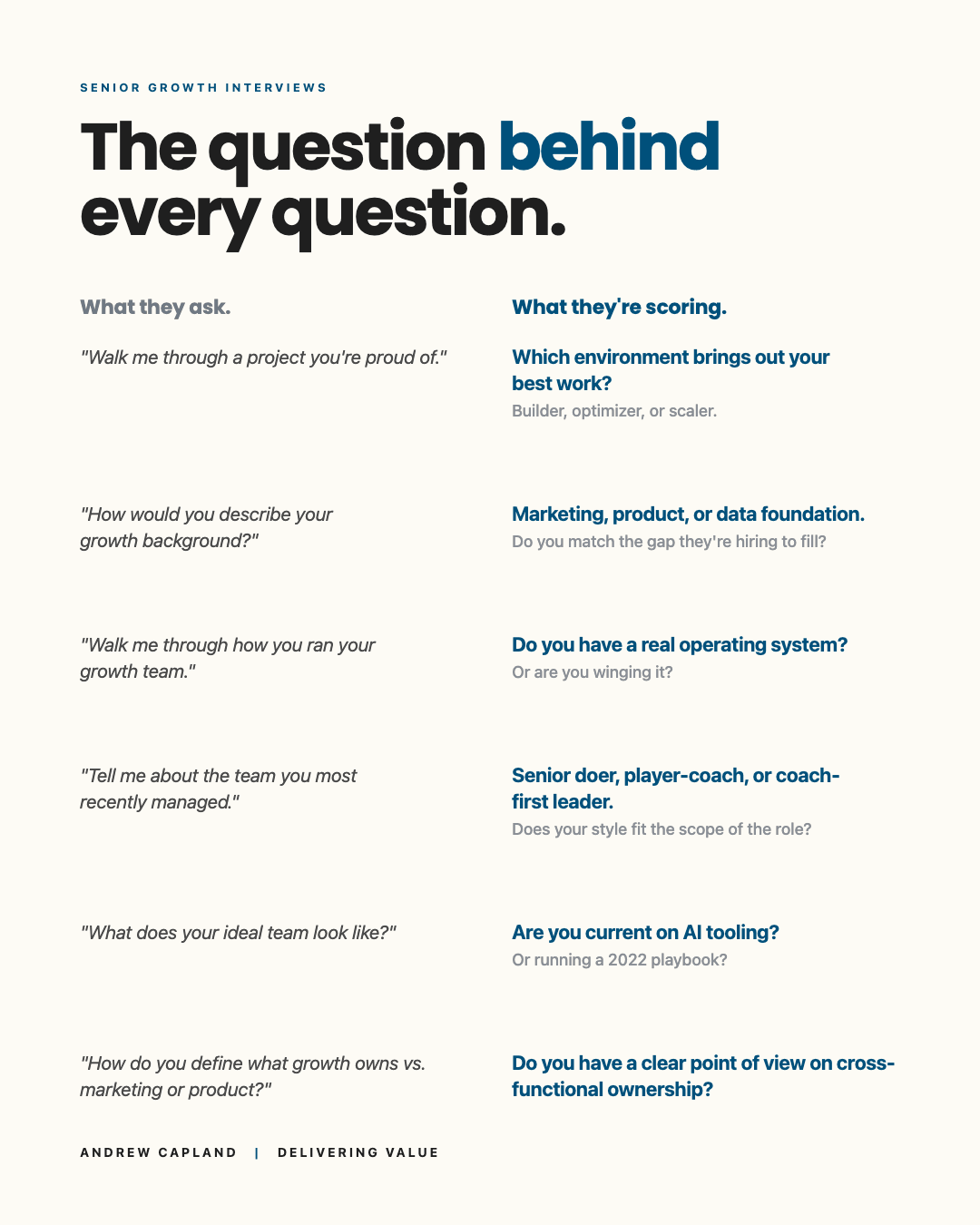
Here’s what I’ve noticed after coaching 90+ growth leaders through dozens of interview rounds (and sitting on the other side of the table as a 2x Head of Growth myself). The questions in a senior growth interview are pretty stable. They’ve been the same six or seven questions for years (with the addition of some AI flavors of those questions). But some of the evaluation is happening under the surface of what’s being asked directly.
In this post, I’ll walk you through three of the most commonly misread ones, because once you see the patterns, you’ll know how to navigate. Or you can watch the youtube video below for a deeper-dive.
1. “Walk me through a project you’re really proud of.”
The literal question is about a project. But the real question is, which environment brings out your best work?
My friend Adam Fishman frames this as three archetypes. Builders go zero to one. Optimizers break through plateaus. Scalers take an already-working growth model and layer new growth loops on top of it.
These things aren’t binary. Most growth leaders are some combination of all three personas. But one of these is your strength. And companies usually know which one they need, even when they can’t quite name it.
When they ask for a “career-defining project,” they’re listening for the environment that made that win possible. Was it total ambiguity, and you constructed your own signal? Was it a stalled growth model, and you diagnosed your way through the plateau? Was it a working machine, and you bolted new loops on top?
The mismatch is what kills most placements. I see it constantly. A scaler joins a Series A startup that actually needs a builder. A builder takes a job at a Series C scale-up that needs an optimizer. Six months in, both sides realize it isn’t working. Neither side saw it coming, because the interview conversation was about results, not environment that produced the results.
So if you’re prepping for an interview right now, the highest-leverage move is to figure out which stage the company is actually in before you walk in. Then pick the project from your background that happened in the same environment.
Most candidates lead with their most impressive results. The candidate who lands the job leads with the story that proves they’ve done their best work in the environment the company is hiring for.
2. “Walk me through how you ran your growth team.”
The literal question is about your team. The real question is, do you have an operating system, or are you winging it?
This is the question my client was missing. And it’s one of the highest-signal questions in the whole interview.
The reason most candidates blow past it is simple. By the time you’re interviewing for a senior growth role, you can talk tactics in your sleep. You know activation loops. You know paid acquisition. You can riff on anything tactical.
But very few growth leaders can describe a coherent operating system to someone who doesn’t live and breathe this work. The rhythm. The cadence. How you set goals, how you prioritize, how you run experiments, how you decide what to track. How decisions get made when you’re not in the room.
A weak answer sounds like: “We had a Monday standup. We used Trello. We communicated on Slack.”
A strong answer sounds like: “Every Monday we reviewed the experiment backlog, prioritized by ICE, assigned an owner. Every other Friday we ran a retro on what shipped and what actually moved the needle. Quarterly we reset goals and tied each one to a single business outcome. Every doc had a DRI and a clear deadline.”
Specificity is what separates someone who’s run a team from someone who’s been on one.
If you don’t have a clear answer to this question, that’s the work to do before your next interview.
After our call, my client went and created an artifact that we called her growth operations manual. Two pages. Decision-making principles, meeting cadence, prioritization framework, KPI ownership across teams. She started weaving it into her interviews.
3. “What resources do you need to be successful in this role?”
The literal question is about people, dollars, and tooling. The real question is, are you current with AI workflows and MCPs, or are you operating from a 2022 playbook?
This one has shifted more than any other question in the past 18 months, and most candidates haven’t updated their answer.
The old answer was about your dream team. Two growth marketers, a PM, a designer, an analyst, and $XXX of budget. That answer might land you the job at a well-funded Series C. It’ll get you politely passed on by almost early startup/scaleup that’s hiring right now.
The companies bringing on growth leaders today are looking for resourcefulness first.
They want to know what you’ve shipped under constraint. They want to know how you actually use AI in your workflow. Whether you’ve used Claude or Cursor to compress a three-week build into a two-day one. Whether you’ve replaced a recurring report with a workflow. Whether you have a point of view on what your team needs to look like in 2026, not 2022.
A great answer sounds like: “I’ve been using Claude Code for our experiment analysis. Saved us about 6 hours a week and freed up our analyst for higher-leverage work. The ideal team for me right now is leaner than it would’ve been two years ago. One growth marketer, one PM, and occasional engineering support as we roll out test winners to prod.”
That answer signals that you understand the current tooling and workflows.
Many of the questions being asked are a proxy for something deeper.
The interviewers are checking whether you fit the stage, whether you have systems, whether you’re current, whether you can hold ground on cross-functional ownership. The words coming out of their mouths are just the way they get there.
If you’re prepping for one of these conversations, here’s the move.
For each question you expect, write down what they’re really asking underneath. Then write the answer to that question, not the literal one. You’ll be in the top 10% of candidates immediately.
One last thing.
The interview cuts both ways. The same questions that tell them whether you fit also tell you whether the role fits for you. If they want a builder and you’re a scaler, this isn’t the right seat.
Better to figure that out in week 2 of interviewing than in month 4 on the job.