


Is there anything worse than having amazing ideas that nobody else listens to?
It drove me crazy when I was leading growth. I could see it was so obvious we needed to prioritize activation. But I couldn’t convince the executives that work was more important than the other stuff they were already focused on.
That’s how I learned there’s a big difference between being right and being effective.
In this piece I'll walk you through the 2 artifacts I wish I'd had at the time. It's where I start with every coaching client.
“I work at a small company. I don’t need artifacts.”
I know that’s what you’re thinking. That’s what I thought too when I first started running growth and marketing teams at startups.
But sharing something once doesn't work.
People forget, new people join, and your execs are juggling 6 other priorities and putting out fires you don’t even know about.
Repetition is an incredibly powerful tool, no matter how big your company is.
The famous “rule of 7” applies.
So having things documented that other folks can refer to when you’re not in the room, that you can train folks on, that you can unveil like a new program or a new feature release, is super important.
Artifacts, whether you like it or not, are an important tool of influence.
Artifact 1: the growth strategy document
The first artifact I work on with every coaching client is formalizing some type of growth strategy document.
At the highest level, a growth strategy outlines what we’re doing, why we’re doing it, what it looks like when we get there.
It explains how you’ll grow faster. This is important for every team. And especially important if you work on a small one.
When I coach folks at super early-stage startups, they sort of scoff at this.
They’ll say something like, “at my company, things are fluid. We move quick here so I don’t need to have things documented. We run things a little leaner.”
But these are the same folks who complain that they’re exhausted from changing direction every few weeks, have trouble saying no to ideas their founders and execs “chuck against the wall”, and struggle to have the impact and influence they want.
If you don’t have something documented, it’s nearly impossible to prioritize. You end up at the whim of whatever ideas are being thrown your way, and it’s really hard to pick the right work because you don’t know what the right work is.
Half the leaders I coach say some version of "I need help saying no to good projects, so I can spend my time on a small number of great ones." The strategy doc helps.
Even just thinking through the questions helps.
What does success look like?
What has to go right for us to be successful?
What projects are part of each of those pillars?
What milestones should I keep track of as we go?
That’s the 80/20 of this process, and a lot of folks don’t do it.
If you skip it, you get overloaded with other people’s priorities because you can’t protect your own.
So here’s my strategy template.
I’ll walk you through it the same way I’d walk a client through creating the first version of their strategy. A good growth strategy includes 6 things.
1. Mission and vision
Mission is what we’re focused on right now. Vision is a more qualitative description of what the future looks like if and when you’re successful.
You can take this a few different ways.
If a core part of your strategy is scaling your team, this could describe what the team looks like when it’s fully up and running. If you’re building a PLG motion, describe what that looks like in the future. Use whatever timeframe the strategy covers. If it’s a 6-month strategy, pitch me what the future looks like if everything goes perfectly in 6 months. If it’s 12 months, take the longer view.
This should be conversational. It’s a bit of a North Star.
A core part of creating these artifacts is sharing them with what I call non-native speakers, people who aren’t in the growth world every day. So describe the future in common-sense language. No acronyms or jargon.
2. The plan: goals, levers, and tactics
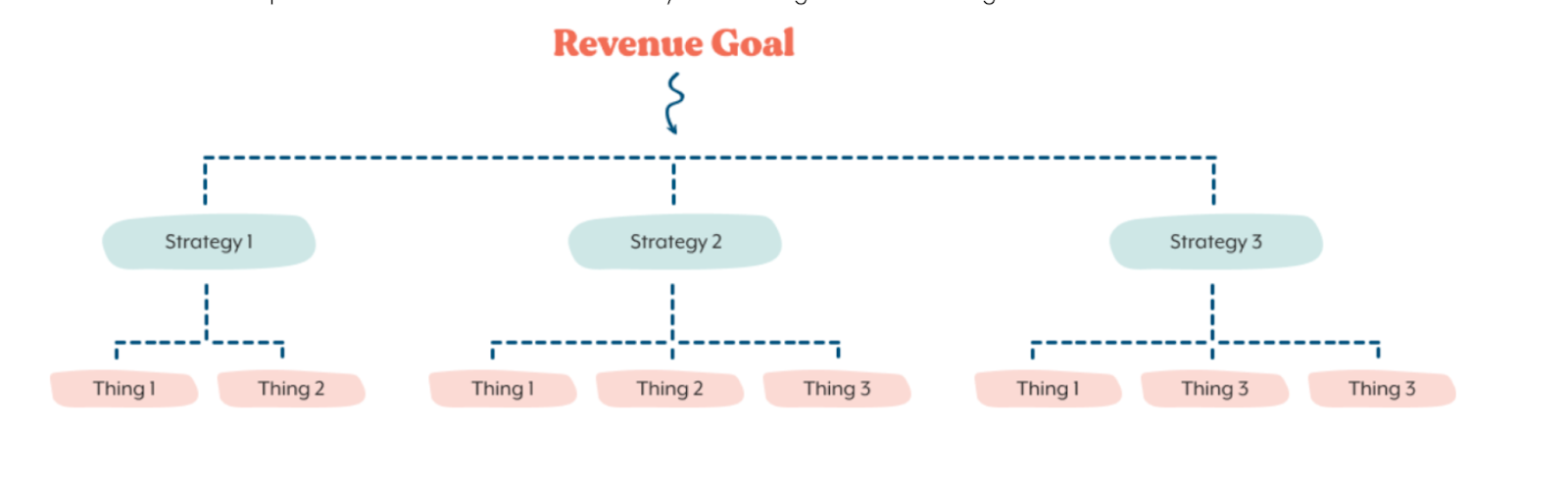
This is probably my favorite part. There are 3 layers.
The goal sits at the top. What's the one number that either gets us promoted or gets us fired at the end of that timeframe? Usually it's an ARR goal. Sometimes it's a customer goal. That's the guiding KPI.
The levers ladder up to that goal. In my experience you can have 2 or 3 main priorities. A lever might be an area of your growth model: acquisition, activation, free-to-paid conversion, retention, etc.
If we’re going to hit the goal, what are the 2 or 3 things we have to nail?
And ideally, phrase them as outcomes. “Increase acquisition from X quality signups a month to Y.” “Increase activation from X to Y.” “Increase conversion from X to Y.” And model them out to make sure that if you’re successful, they actually ladder up to the goal.
Do the math. If the goal is $12M in new ARR and better activation gets you $7M at your current conversion rates, the other 2 levers have to cover the remaining $5M. If they can’t, you either need a 4th lever (and more resources) or to negotiate a smaller goal, and it’s a lot better to have those conversations now than in month 9.
The tactics are the third layer. What’s the “stuff” you’re going to do to achieve each outcome? These may look like specific programs, campaigns, tests, or other initiatives in your backlog.
You’re probably thinking, “But I do more way more stuff than this.”
When I think about a strategy, I think of it as 80% of your focus, resource-wise and time-wise. There’s always other stuff outside of it.
This is the work that’s most important to your success, the stuff where, if it doesn’t go well, the team probably isn’t going to be successful.
I like to do this visually because I’m a visual person, but a list works too.
3. OKRs: how you’ll measure success
The levers are the bets. Key results are the early checkpoints that prove a bet is working before the ARR shows up.
Objectives read almost like the levers: “Get new users to value faster.” Key results are the 2 or 3 numbers you’d check at the 90-day mark. “Activation from 22% to 30%.” “Time to first project under 3 days.” If those are moving, the ARR follows. If they’re not, you know 2 quarters early instead of at the end.
This is you saying, “In the future, if I’m successful, here are a couple things I’ll be excited to tell you about that are early indicators I’m on the right track.”
4. A visual roadmap
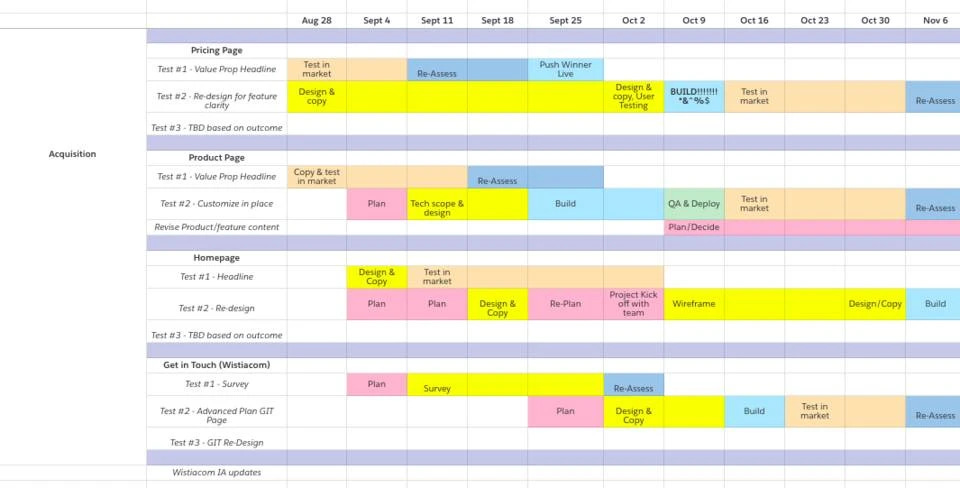
Once you’ve got the goal, the 3 levers, and the tactics, you want a picture of how you’ll sequence the bets. Ideally that’s a mix of quick wins, and some long-term, high-effort, high-impact projects that pay off later.
You need some way to visualize the order of operations, both for yourself and for the folks you’ll be sharing OKR results with down the road.
Here’s an example:
5. The resources you need
Resources come in a few flavors.
People, whether that’s contractors, in-house folks, agencies, or freelancers. Agents could be part of this in 2026 and 2027.
Tools, meaning the tech stack you need to execute.
And budget, the cost to acquire the resources or run the plan.
Some of these asks will need approval, and the earlier you can say “here’s what we need to achieve the plan,” the more successful you’re going to be.
6. Risks
Here’s how I frame this with execs (if I’m presenting).
We’ve just outlined a plan that’s going to help us win. But if I’m up in front of the room X months from now and the story isn’t “we absolutely crushed it,” these are the things that could pop-up and derail us along the way.
It could be things that are in your control, like budget issues, hiring challenges, or channel costs rising.
Or they could be things outside your control like market conditions, competitor funding, challenges in the acquisition landscape, other dynamics we can’t always predict.
Whatever you can see that might impact your success, highlight it so nobody’s surprised later.
And ideally, if you’re behind on your OKRs and one of the risks you outlined is happening, you can adjust. Re-sequence, or revisit your priorities, and keep going.
Those are the 6 things to include in your strategy.
Some teams include more, some include less. But this is a good starting point.
Together they answer what we’re working on, why we’re working on it, and what success looks like if we absolutely knock it out of the park.
Artifact 2: the operations manual
The strategy answers what we’re working on and why. The operations manual outlines how we’ll approach the work.
This matters because working in growth is different from working in a core marketing, product, or data function.
The way we approach the work is different. The way we run experiments is different. The way we collaborate with other teams is different. The lines of ownership and accountability are different.
Growth as a capability is still new and still evolving, and if we’re not proactively communicating how we approach the work, we’re going to hit a ton of cultural roadblocks down the road.
It’s also important if you’ve inherited a team, or you’re leading a team that isn’t changing and evolving the way you need them to. If they’re not thinking big enough. Or defaulting to the way they’ve always done things.
This artifact lets you point at something and say, “This is how we operate as a team. You’re outside of that right now. Let’s talk about how to align.”I use it to coach the team, to give feedback in one-on-ones, and as part of the review cycle.
It’s a lot easier to give that feedback when you’re pointing at an artifact.
Combined with the strategy doc, it makes onboarding easy, whether that’s an executive stakeholder above you, a cross-functional partner, or a new direct report.
The 2 documents should live in a shared file system, link to each other, and get updated consistently, because things are changing fast right now.
Here are the 8 things a great operations manual includes.
1. A link to the current growth strategy
A link or a summary, so everyone understands what we’re focused on, why it matters, and how we win.
2. Team structure
Because growth is so new and unique, outline what the team looks like today. Both the roles and their jobs to be done today. Then include a future version of the team so other folks understand how it scales and evolves.
You’ll want to include things like:
What are the individual roles on the growth team?
What does each role focus on?
Who does each role report to?
3. KPI scorecard
A mix of OKR-type metrics that are tightly aligned with the strategy, plus stuff outside the current strategy that’s related to our work and worth watching. Include not just the metrics but the owner of each one, and who gets alerted if a metric falls into yellow or red. If something starts underperforming, who needs to know?
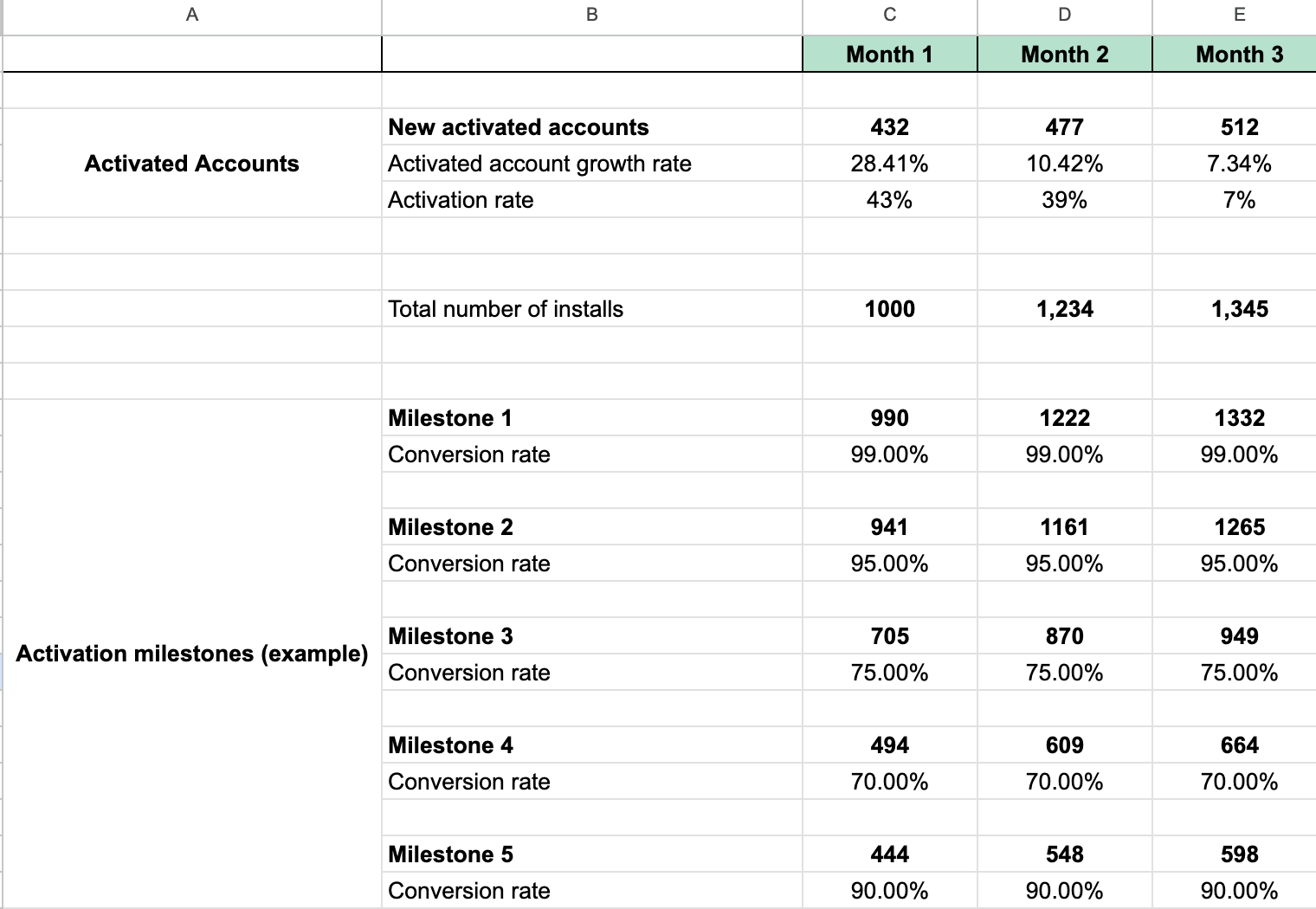
Not sure what to track? Feel free to use my product-led tracking example. It has a mix of high-level metrics and drill-down views.
4. Team values and operating principles
These are specific guidelines for how the team makes decisions and gets the work done and are incredibly helpful for creating cultural change.
Examples include things like:
Focused on learning & sharing to enable other areas of the organization
Providing value to the user as quickly as possible
Putting the users’ opinions over your own
Using data to make decisions
Experimentation before deep investment
Bias for simple solutions that scale
When clients tell me “my team isn’t taking enough risks, they’re defaulting to how they’ve always done it, I can’t get them where I need them,” values are almost always where I start.
5. Operating procedures
This is the boring stuff that eats your week if it isn’t written down.
These are different at every company and in every moment. But typically: the systems the team needs, how they request work from copy or design, the process for supporting a feature launch (who to involve, how we collaborate).
If there are docs or templates, link to them here.
6. Cross-functional rules of engagement
Growth works way more cross-functionally than traditional marketing, product, and data teams. If you’re not explicit about both the KPIs and the surface area, people bump into each other or get left out of the right work.
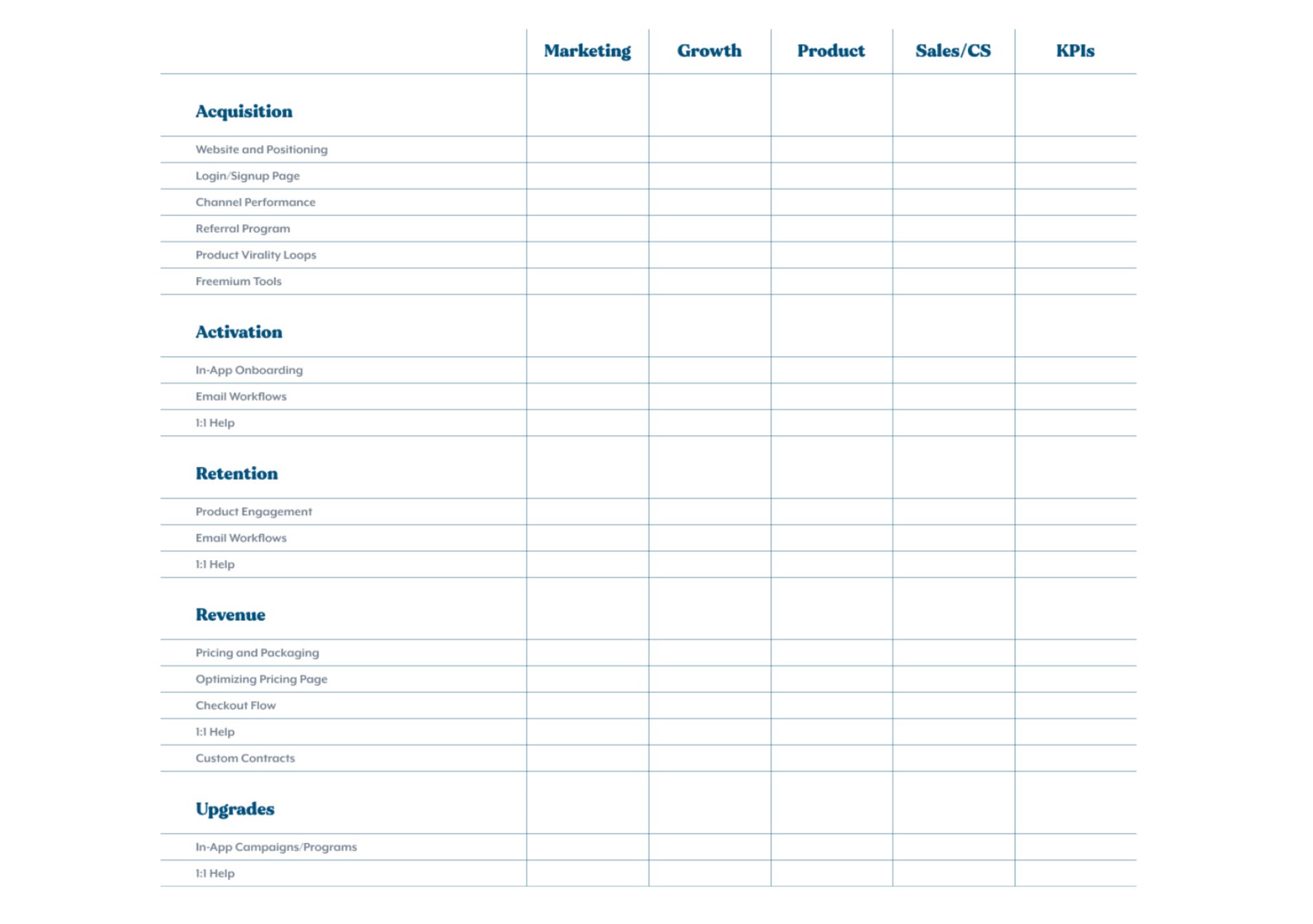
The easiest starting point is a RACI matrix: who’s responsible, who’s accountable, who’s consulted, who’s informed.
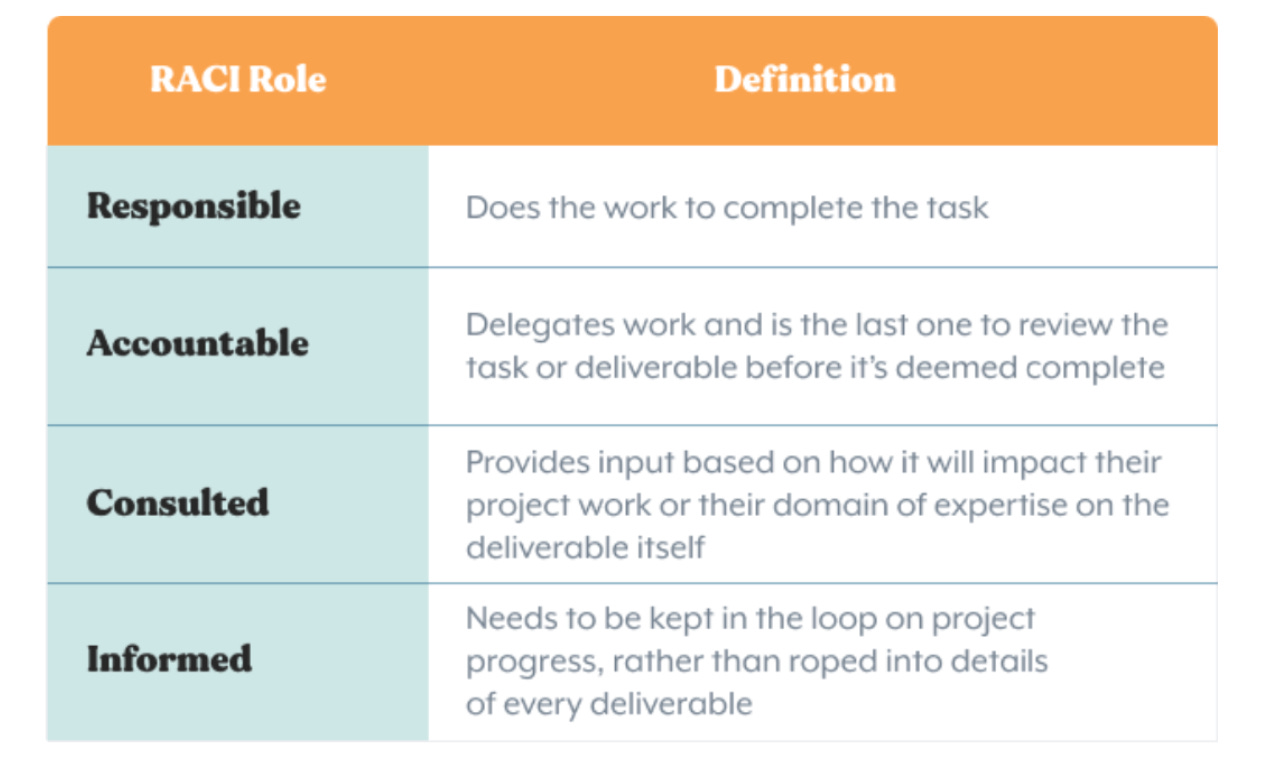
Do it for both the KPIs and the surface area, meaning the shared real estate: the pricing page, the onboarding flow, lifecycle emails, in-app messaging, wherever growth and product or marketing both have their hands.
You’ll want to create something like this document below, and fill in with the appropriate letters from the RACI definition above. The more explicit you are, the more successful you’ll be.
7. Meeting structure
Some meetings are for planning. Some are for learning and analysis. Others are for alignment and decision-making. The more explicit you are about which meeting is for what, the quicker the team operates and the more you can pull yourself out of the weeds as you scale.
8. Experimentation process
Growth teams are usually at the iteration stage of company growth. Which means lots of A/B testing. And if you’re running a lot of tests, you should outline how you run tests.
Link to an experiment doc template.
Link to a prioritization rubric, something like RICE or ICE.
And have somewhere to log results, win, lose, or draw, so you get better over time.
You can use AI to assist in the process, but outline what good looks like so people can go fast and you can eventually shift from executing to reviewing.
Those are the 2 most important artifacts every Head of Growth should create.
The strategy helps everyone understand what we’re doing and why. The operations manual helps everyone understand how we’ll approach the work.
Next time an exec throws an idea at you, you won’t be arguing. You’ll be pointing at something. That’s the transition from being right to being effective.
If you'd rather watch this than read it, here's the full walkthrough, including the templates on screen.
And if I can help you make that transition, that’s exactly what I do as a coach. Set up a consult and let’s see if we jive.